TB-500 is the research form of thymosin beta-4, one of the body's most abundant actin-binding peptides. Preclinical studies suggest it supports tissue repair by regulating the machinery of cell movement — letting repair cells migrate to injury sites.
Thymosin beta-4 is a naturally occurring 43-amino-acid peptide present in almost all human and animal cells, first isolated from the thymus gland. It is concentrated in wound fluid and platelets — the body's repair toolkit.
Its mechanism is genuinely distinctive: TB-500 binds G-actin and regulates actin polymerisation — the cytoskeletal machinery of cell movement — allowing repair cells to migrate where they are needed. It also promotes angiogenesis and moderates inflammatory signalling during the repair phase.
Animal studies suggest faster functional recovery and reduced scarring in muscle and tendon injury models. Pharmaceutical versions of the full molecule have reached Phase 2/3 human trials in eye-drop and wound-gel form.
Findings from the published literature, with the evidence level stated honestly for every claim.
One of the most abundant actin-binding peptides in the human body, present in nearly every cell type.
ChemistryRegulates actin polymerisation — the machinery repair cells use to move — rather than a single growth-factor pathway.
MechanismPharmaceutical thymosin beta-4 formulations (RGN-259 eye drops, RGN-137 wound gel) have reached Phase 2/3 human trials.
Human · related forms| Compound | TB-500 (thymosin beta-4) |
|---|---|
| CAS number | 77591-33-4 |
| Molecular weight | ~4,963 Da |
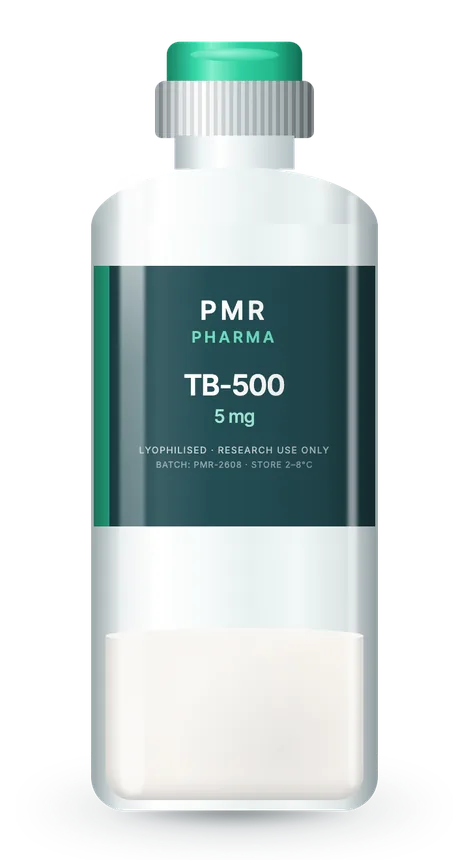
| Content | 5 mg — lyophilised vial |
| Purity | ≥99% (HPLC) — batch COA supplied |
| Form | Lyophilised powder |
| Storage | −20 °C long-term; reconstituted 2–8 °C, swirl only |
TB-500 is larger and more structurally sensitive than short peptides. Keep lyophilised at −20 °C for long-term storage, away from light and moisture. After reconstitution refrigerate at 2–8 °C and avoid shaking — swirl gently.
They act through different mechanisms — TB-500 on actin-regulated cell migration, BPC-157 on angiogenesis and growth-factor pathways. That mechanistic complementarity is why the two are the classic pairing in recovery research.
Injectable TB-500 itself has not completed human trials. Pharmaceutical formulations of the same parent molecule have reached Phase 2/3 trials as eye drops and topical wound gels.
At ~4,963 Da it is a comparatively large peptide, and vigorous shaking can damage its structure. Swirl to dissolve, never shake.
Yes — third-party HPLC and mass-spectrometry testing per batch, with matched batch numbers on vial and COA.
Message us on WhatsApp for availability, batch COAs and dispatch. A real person replies — usually within the hour.
Enquire via WhatsApp